Showing posts with label Maya. Show all posts

Monday, October 25, 2010

Chiapas … A Paradise for Tourists,

but Definitely NOT “Touristy”!


Video courtesy of the State of Chiapas.

A street in San Cristobal de las Casas’ historical district is filled with locals and visitors.
I’m frequently asked, by many who read my articles about Mexico, “Where can I go in Mexico that’s not “touristy?” Well, after you read this, you will know. Not that I, personally, don’t like those destinations in Mexico that cater to tourists, because I love all of those places (after all… I’m a tourist). Chiapas is bordered by the states of Tabasco to the north, Veracruz to the northwest, and Oaxaca to the west. To the east Chiapas borders Guatemala and to the south, the Pacific Ocean. Having traveled extensively in Mexico for several decades, I am amazed that there still is an area… a state… so beautiful, that isn’t heavily traveled by tourists. Mountains… valleys… rainforests… mist forests… rivers… Maya ruins… lakes… white water rafting… colonial haciendas… this state has it all! Chiapas is a destination that has been difficult to reach, to say the least, up to now.

To visit any points of interest in the state has required a flight from the U.S. to Mexico City (or other destination) then a short flight to Tuxla Gutierrez, the capital city, then a drive to San Cristobal de las Casas, or elsewhere. Palenque was (and still is) more easily reached by flying into Villahermosa in the state of Tabasco, though. Continental Airlines has twice-weekly direct flights from Houston to Tuxla Gutierrez coupled with twice-weekly return flights and as all arriving flights are in the evening, I checked into the Crown Plaza Tuxla Gutierrez for the night. This hotel is every bit as luxurious and comfortable as the others around the world and I nestled in for dinner. The restaurant in the hotel is large and well-staffed and unlike what you might imagine in a Crown Plaza, offers many very authentic typical Chiapanecan dishes, so even thoughyou may be starting a trip deeper into the Maya experience and more jungle adventure oriented, you don’t need to start with “tourist food” as much of the food in Los Helechos restaurant in the hotel is excellent and authentic.

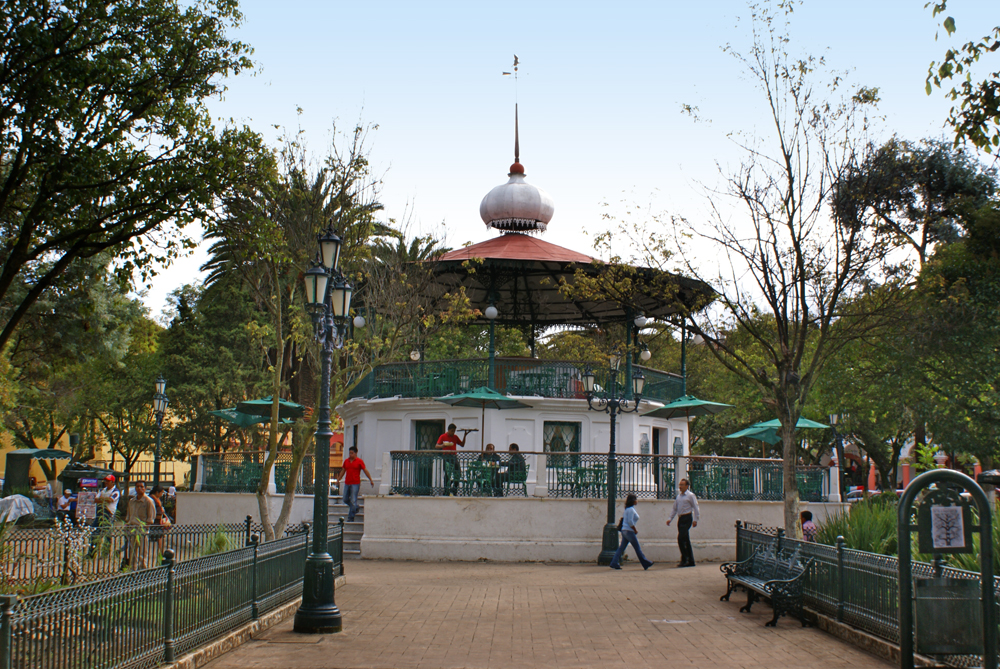
As my ultimate destination was the town of San Cristóbal de las Casas and villages and two Tzotzil towns more easily reached from there,I headed out early in the morning (it’s a nice drive of less than two hours). I checked into the Hotel Ciudad Real Centro Historico, which was (like many other boutique hotels in San Cristobal) an old hacienda. For me, the main attraction here was access to the main historical district square, or Plaza 31 de Marzo (the city was founded on the 31st of March), surrounded by public buildings and enhanced at night by romantic lighting with live music being played in the pavilion (built in 1895).
The main square in the historical district of San Cristobal de las Casas is for relaxing, socializing and romantic strolls.

There are two indigenous villages of these people near each other... San Juan Chamula and Zinacantán. My first stop in Zinacantán was an indigenous home with traditional hats, and other clothing for sale.

Two visitors from the U.S. try on traditional Tzotzil Maya costumes in a Zinacantán shop

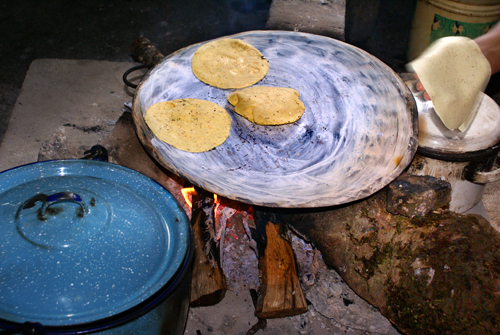
In back of the shop, I was treated to some typical foods being made on a comal over a “camp fire” on the floor of the room used as a kitchen. Visitors were also offered a tasting of posh, a relatively potent liquor made from corn and sugar cane.

A young Tzotzil woman makes tortillas on a comal over an open fire in her home.
In Tzotzil Maya Village Zinacantán, life revolves around San Lorenzo Church.
In the village of Zinacantán, the church is huge and adorned with many beautiful retablos as well as by entire walls covered with gold. The Tzotzil Maya people here practice a combination of ancient pre-Spanish Maya religion and Catholicism and while they may be in a Catholic church, they may be chanting to a Maya god in their prayers. After wandering around the church admiring the art on the walls,I left it to head to the village of San Juan Chamula... but looking back over my shoulder as I left the church, I noticed a sign in Spanish admonishing the worshipers to not sacrifice chickens within. Not fully understanding the significance of the sign, I continued to San Juan Chamula (Chamula is the original Tzotzil name and San Juan is the Spanish name) and found there a village where the Tzotzil traditions and language dominate the daily life.

In San Juan Chamula, hundreds of Tzotzil Maya vendors fill the square
of San Juan Bautista church.
 It was Saturday… market day… and hundreds of villagers were buying and selling fruits, veggies, chorizo, amber, chicharones, snails, turkeys and fish in booths in the yard of the Church of St. John (San Juan Bautista). Lazy Mexican streets dogs sprawled around everywhere. No police were in evidence, yet pairs of religious"authorities" wandered around the square, receiving the respect of all. They wore traditional Maya costumes and carried black batons over their shoulders as a symbol of their authority. I quickly found that I was not allowed to photograph these authorities, nor could I take photographs in the church.

After I was allowed no photos, I brought home this old postcard.

So, after a search of my camera by authorities and an explanation to them from my guide that I had no place to leave my camera, I was allowed to enter the church. No pews. No altar. Just an expansive marble floor with a few dozen Maya kneeling on the pine needles that were spread all over the floor. Each worshipper had made his/her own "altar" on the floor and had planted as many as a hundred candles with melted wax on the floor. Along the walls were dozens of tables covered with hundreds... no, thousands of candles, which were the only lighting within. Worshipers were chanting prayers to various Maya gods, as well as to their various patron saints, whose statues are in niches around the circumference of the room dressed in traditional Tzotzil garb. No clergy are allowed nor Catholic rites practiced in the church now. Some worshippers had chickens that they were praying over and offering their sacrifice to the gods before wringing the necks of the chickens. They then took the chickens to their homes and cooked them for dinner.

Now, before you go thinking about how “barbaric” this is… consider the fact that we Christians, Jews and many other religious practitioners offer our meals in honor of God as we thank him for the meal in the form of “saying grace” before eating. I submit that there is no difference here except that these very religious Maya offer thanks to their gods before they kill their dinner rather than after they kill dinner, as we do. Most of the celebrants who pray under the guidance of a shaman to remove negative energy or illness, drink posh…. The shaman also spits posh on the person who is ill then passes chickens and eggs over the sick person to absorb and retain the illness.

I have said “Tell me what you know about the Maya and I’ll tell you what you know about Mexico.” I found out on this trip how little I knew about the Maya.

I headed back to San Cristobal after the long day of studying ancient Maya traditions and looked forward to an adventurous day in the morning, visiting Sumidero Canyon, AMIKÚU Park (contact with pythons, ocelots and exotic birds) and some of the obligatory breathtaking zip-lining at the park. More on this must-do-in-your-lifetime trip in my next installment, Chiapas II.

Meanwhile, some useful links are:
http://www.visitmexico.com/wb/Visitmexico/Visi_Chiapas
http://www.visitmexico.com/work/sites/Visitmexico/resources/LocalContent/6333/17/sancr_cg.pdf
http://www.mexonline.com/sccasas.htm
www.ciudadreal.com
www.diegodemazariegos.com
www.casamorado.com.mx
www.casamexicana.com
www.tierraycielo.com.mx
www.plazamagnolias.com.mx
www.crownplaza.com
www.turismochiapas.gob.mx/


Coming in Chiapas II article, a trip through Sumidero Canyon…
and zip-lining, rappellingand animal contact in Amik
úu Park.

How to make Tortillas

 I asked my Yucatan peninsula food mentor, David Sterling of Los Dos Cooking School in Merida for a recipe for the tortillas I tasted in the Tzotzil Maya home in Zinacantán and he offered a “method”… not a recipe for the way the Maya have been making tortillas for 3000 years. As I can find tortilla “recipes” everywhere through Google, I liked the idea.
There really is no such thing as a true "recipe for tortillas". There is, however, a recipe for nixtamal, but it isn't terribly interesting: 2 k dried field corn kernels, covered with water, add 4 Tbs. calcium hydroxide (used by the Maya for thousands of years!), bring to a boil, then let it sit overnight. Rub the corn between your hands over and over while rinsing to remove the pericarp. When the water runs clear, grind the corn. That is how we make masa, and from masa we make tortillas. You form a little ball of the masa, then pat out on a flat surface and place on the hot comal. As you can see, it isn't really a "recipe", but rather some instructions for the process. Real tortillas have nothing in them other than masa made from nixtamal.

Thursday, August 19, 2010

Cobá, a Day Trip from Cancun

Swimming in cave cenotes is an activity offered by several adventure expedition
companies in the Tulum/Cobá area. Photo by Lori Federico
Cancun is far more than the close-by exciting destination that we all read about in the travel magazines (and my blog, of course). It’s far more than the tiny village that I watched grow into a mega-resort since my first visit 34 years ago. It is the ultimate base in Mexico for exciting “day trips”. So, anticipating what this “day trip” would offer, I awaited the van to transport several other visitors and me into the Yucatecan jungle, expecting an Indiana Jones-type adventure.

How indeed would lunch, in part to be cooked in a bucket on an open fire in the jungle, compare with my posh Cancun hotel breakfast in bed?

Actually, it is one of myriad of day-trips available to broaden the Cancun travel experience. The van pulled up on time, bearing our trim, very fit jungle guides. Together, we motored south along the Caribbean through the Riviera Maya. At Tulum, we headed west, deep into the verdant jungles of the state of Quintana Roo.
A lazy Mexican street dog is interested in Altournative’s jungle van.

The AllTourNative van arrived and I shared my cup of coffee with our sleepy-eyed guide, Jeanette, and we hit the road in the direction of Tulum. Good roads made the two-hour ride into the jungle easy and comfortable, and the informative conversation prepared me for my day’s experience.

A Hanal Pixán altar is offered to a Maya ancestor.     
We arrived in the little Maya village of Cobá comfortably after sunrise and met the village elders. Mario then led us on a brief walk. Wild turkeys, chickens and friendly street dogs (God help me… I love Mexican street dogs) lazily stepped out of our path through and around Cobá (named and inhabited by descendants of the ancient Maya archeological site that we would visit later). We visited during the weekend of Hanal Pixán, an ancient purely Maya celebration unique to the Yucatan, similar to El Dia de los Muertos (the Day of the Dead) which is really a Mestizo event celebrated more in other regions of Mexico. Inhabitants busily competed in building spectacular altars honoring their ancestors. The stop and the short tour delayed our rappelling and zip-lining, but were worth the time.

Our wanderings soon ended atop a cliff, nature’s wall at a jungle ravine. There, our eyes slid down a long rope to a clearing near a small pool of water. The rope was about the only way to get down there alive. When Mario asked who would slide first, dead silence screamed back at him from the 30-somethings in our group. Deciding that Alltournative had nothing to gain by publicly killing off travel writers, I stepped to the edge of the cliff, embraced technique instructions, then heroically stepped off backwards, slid effortlessly down the rope and landed on my feet. Amazing. I was followed quickly by the others.

All down, we followed a long trail to a tall wooden platform high in the jungle canopy. A long cable extended beyond sight through the tree tops to a landing pad. Again, Mario asked, “Who’s first?” Again, no one said a word. It was up to me. I figured “I’ve had a good life… why not?” I stepped up and climbed into the safety harness, then suddenly rushed along a sturdy cable through the treetops. My seemingly-super speed slowed as the cable took an upward turn and I enjoyed a comfortable landing. Another “daring” maneuver completed, I found my prior anxiety unwarranted. I would attempt to be the first for everything from now on!

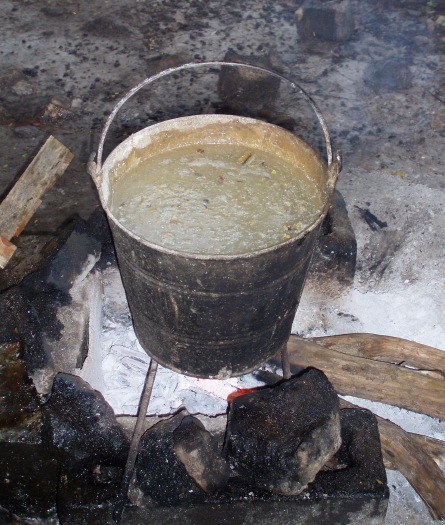
A bucket of corn kernels boils over a campfire 
in preparation of lunch.  
Hungry and tired from jungle commando tactics, we headed to the primitive outdoor dining room set up to feed the village’s guests. Ready and waiting, the aromas of these rich, colorful Maya-rooted dishes were mouthwatering. Just outside the dining area, a bucket of crushed corn kernels in water was bubbling away on a campfire. Instead of tortillas, this thick corn mush is spread on a hot cooking surface to make empanadas and other traditional dishes.
Achiote, grown in every village yard, liberally provides food with a very light seasoning and a rich, dark, red color. Chicken with achiote, a Cobá favorite, quickly became mine, too.


Achiote Chicken is prepared for guests of the Maya village, Cobá  
We all enjoyed both the traditional foods and the respite in preparation for our next adventure.

Reluctantly re-boarding the van, we left the road for a jungle lagoon a quarter mile away. Jostling around on the bumpy dirt vehicle path, I quickly understood why the van had a few dents.

Kayaking through a jungle canal is on the agenda
We reached piers jutting out into the jungle lagoon… a man-made cut for navigation in colorful kayaks through dense vegetation. Drenched from the steady rain that had increased from a morning drizzle, we soon left the kayaks for a steep muddy path to the mouth of the cave. A shaman in a shelter at the cave’s entrance consecrated the group and let the spirits know that we were coming and meant them no harm. After some chanting and burning of incense, we thanked the shaman for his ritual and headed toward the cave opening, noticing for the first time that the shaman had a tip jar.
Achiote is grown in the yards of many families
 in the Maya village of Cobá

Crawling feet-first on hands and knees about 15 feet through a narrow passageway, we came to wooden stairs we could follow over 100 feet down into the darkness to what turned out to be a deep, beautiful, clear cave cenote. I heard a splash and saw guide Jeanette swimming in the cool water. Before long, we all refreshingly joined her, then, headed back to the van to bid adios to the Cobá area. Driving back into the jungle on a secondary road, we drove through exotic terrain. Colorful parrots flew everywhere. Spider monkeys replaced dogs as household pets. Jaguars, much revered, held to their jungle safety… and, thankfully, we saw none (but assumed that they were there, as they are protected by the Mexican government).

This temple at Cobá is the second tallest in the Yucatan peninsula.  
An hour later, we arrived at the ruins of the ancient Maya city and village namesake of Cobá, one of the oldest Mayan architectural sites on the Yucatan peninsula. Its name meaning “waters stirred by wind”, Cobá thrived during the Classic period (600-900 A.D.), yet may have been previously inhabited for as much as 1,000 years.

The Observatory
A local guide walked us through the first group of buildings (Grupo Cobá) as far as the ritual ball court. Some of us rented bicycles, riding a gravel road a quarter-mile into the jungle to see (and for me… to climb) the main pyramid (the peninsula’s second tallest) and to view the well-preserved observatory.

As dusk quickly approached, we headed back in the van to the 21st century luxury of our Cancun hotel after a full day of adventures that we thought Indiana Jones would have enjoyed and envied.

The well-worthwhile day (12 hours-plus) costs about $120 per person, including lunch, experienced guides and transportation.
For more information, see:
http://www.alltournative.com on the Internet.
http://cancun.travel/en/

It would seem that this would be the perfect place to offer a recipe for an achiote chicken dish, but I just posted one for Pollo Pibil in my last article on Uxmal. Refer to it if the idea of the achiote chicken interests you… however, my resident expert on dishes typical to the Yucatan is Chef David Sterling of Los Dos Cooking School in Merida. He suggests that you try to cook outside of the Maya box and prepare a Crèma de Aguacate. Not truly Mayan, as most of the ingredients are post contact, but it is popular on the peninsula.


CREMA DE AGUACATE
Creamy chilled avocado soup

Tuesday, July 13, 2010

UXMAL, State of Yucatan

Tell me what you know about the Maya 
and I’ll tell you what you know about Mexico.
The Temple of the Magician, believed by Mayans to be built overnight by a dwarf magician.
In an on-going effort to visit all of the dozens of Unesco World Heritage Sites in Mexico, I visited Uxmal on several occasions. It is a ruined Mayan city which, it is assumed, was founded between the year 500 A.D. and the year 700 A.D. I usually only spend a little more than an easy half day in the once-thriving city on each trip here.

Uxmal's Ball Court . . . a familiar fixture in most Mayan cities
Wandering the grounds of this complex, I highly recommend using a guide (available gathered in the entrance area and Information Center). I used guides on my first two visits here and they talked about the history of Uxmal. I can’t imagine how much I would have missed had I done it alone.


The view through a Mayan arch
The hardest thing to describe about Uxmal is the quiet. Not the quietness… but the quiet. As I wandered the compound, I was struck by the overwhelming sense of silence there. There were sounds… there were voices of tourists… there was a haunting sound of wind. But, above and through it all, it was quiet. It was a holy place, I felt. It was as though someone had blown a horn one morning and an entire civilization just got up and left. Eerie.

For nature enthusiasts who enjoy birds, Uxmal is as heavily populated today as it was when the inhabitants were Mayans. Even the non-exotic species here draw your attention more than they do at home. The trees surrounding the Pyramid of the Magician look, from a distance, like they are populated by huge dark bats hanging and waiting. A closer inspection, however, reveals that these are Oriole nests and are homes to the beautiful commonplace Oriole. Everything here takes on a surreal air.
A Turquoise-browed Motmot

Cisterns and wells were used to gather and hold water when this city was viable and a leaning peek into one of those caused me to leap backwards to avoid the escape flight of a frightened Motmot. As an amateur birder, I always love Mexico, as most of my birding experiences are in the United States and limited to species far less exotic than parrots and Motmots. While the colorful Motmot is Nicaragua’s national bird, they are found throughout the Yucatan area and south in Mexico and are characterized by a long slender tail with a heart-shaped feather at the end, which vibrates like a harp.
The Nunnery Quadrangle


Upon entering the Nunnery Quadrangle (a name given it by the Spaniards), which is a three-tiered government complex, I was struck by what looked like a large black garbage bag abandoned atop the tallest structure in the complex. Moving closer, I added another bird to my list as I approached (unsuccessfully) what turned out to be a huge King Vulture…not a garbage bag.
Climbing and exploring most of the
structures of Uxmal is allowed.
Climbing is allowed on some structures at Uxmal and some of the most dramatic views of the overall complex may be had from atop the tallest structures. The Gran Pyramide: (The Great Pyramid) is one of those tall buildings I climbed and the view is spectacular, but I will warn those of you with acrophobia that going up is easier than coming down. The old saying “Don’t look down!” doesn’t work when you have to look down to place your feet correctly. Look down or fall down.

It’s not my intent here to educate anyone about the history of the Maya…only to interest you in finding out more about them by traveling there. A visit to Uxmal is fun and instructive. It is only 78 km (48 miles) from Merida on the way to Campeche.
When you leave here, you will understand, far better, the roots and beginnings of the Mexico we love and visit today. However, if you stay in the area and you are lucky enough to meet a Mayan family and be invited to dinner, they might start off the meal with a botana of Sikil P'aak (Sikil Pak), a typical ancient Mayan dip of ground pumpkin seeds, tomato and onion.
Our friend David Sterling of LOS DOS Cooking School in Merida specializes in typical dishes of the Yucatan and he teaches this "slightly kicked up" version of Sikil Pak in his cooking school.


SIKIL P'AAK
Vegetable Dip of Toasted Squash Seeds, Roasted Tomatoes and Chile