Showing posts with label achiote paste. Show all posts

Thursday, August 19, 2010

Cobá, a Day Trip from Cancun

Swimming in cave cenotes is an activity offered by several adventure expedition
companies in the Tulum/Cobá area. Photo by Lori Federico
Cancun is far more than the close-by exciting destination that we all read about in the travel magazines (and my blog, of course). It’s far more than the tiny village that I watched grow into a mega-resort since my first visit 34 years ago. It is the ultimate base in Mexico for exciting “day trips”. So, anticipating what this “day trip” would offer, I awaited the van to transport several other visitors and me into the Yucatecan jungle, expecting an Indiana Jones-type adventure.

How indeed would lunch, in part to be cooked in a bucket on an open fire in the jungle, compare with my posh Cancun hotel breakfast in bed?

Actually, it is one of myriad of day-trips available to broaden the Cancun travel experience. The van pulled up on time, bearing our trim, very fit jungle guides. Together, we motored south along the Caribbean through the Riviera Maya. At Tulum, we headed west, deep into the verdant jungles of the state of Quintana Roo.
A lazy Mexican street dog is interested in Altournative’s jungle van.

The AllTourNative van arrived and I shared my cup of coffee with our sleepy-eyed guide, Jeanette, and we hit the road in the direction of Tulum. Good roads made the two-hour ride into the jungle easy and comfortable, and the informative conversation prepared me for my day’s experience.

A Hanal Pixán altar is offered to a Maya ancestor.     
We arrived in the little Maya village of Cobá comfortably after sunrise and met the village elders. Mario then led us on a brief walk. Wild turkeys, chickens and friendly street dogs (God help me… I love Mexican street dogs) lazily stepped out of our path through and around Cobá (named and inhabited by descendants of the ancient Maya archeological site that we would visit later). We visited during the weekend of Hanal Pixán, an ancient purely Maya celebration unique to the Yucatan, similar to El Dia de los Muertos (the Day of the Dead) which is really a Mestizo event celebrated more in other regions of Mexico. Inhabitants busily competed in building spectacular altars honoring their ancestors. The stop and the short tour delayed our rappelling and zip-lining, but were worth the time.

Our wanderings soon ended atop a cliff, nature’s wall at a jungle ravine. There, our eyes slid down a long rope to a clearing near a small pool of water. The rope was about the only way to get down there alive. When Mario asked who would slide first, dead silence screamed back at him from the 30-somethings in our group. Deciding that Alltournative had nothing to gain by publicly killing off travel writers, I stepped to the edge of the cliff, embraced technique instructions, then heroically stepped off backwards, slid effortlessly down the rope and landed on my feet. Amazing. I was followed quickly by the others.

All down, we followed a long trail to a tall wooden platform high in the jungle canopy. A long cable extended beyond sight through the tree tops to a landing pad. Again, Mario asked, “Who’s first?” Again, no one said a word. It was up to me. I figured “I’ve had a good life… why not?” I stepped up and climbed into the safety harness, then suddenly rushed along a sturdy cable through the treetops. My seemingly-super speed slowed as the cable took an upward turn and I enjoyed a comfortable landing. Another “daring” maneuver completed, I found my prior anxiety unwarranted. I would attempt to be the first for everything from now on!

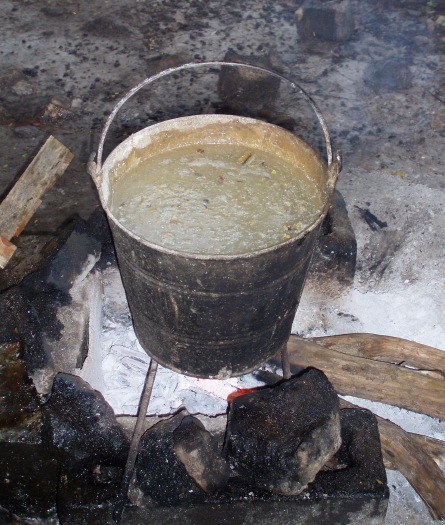
A bucket of corn kernels boils over a campfire 
in preparation of lunch.  
Hungry and tired from jungle commando tactics, we headed to the primitive outdoor dining room set up to feed the village’s guests. Ready and waiting, the aromas of these rich, colorful Maya-rooted dishes were mouthwatering. Just outside the dining area, a bucket of crushed corn kernels in water was bubbling away on a campfire. Instead of tortillas, this thick corn mush is spread on a hot cooking surface to make empanadas and other traditional dishes.
Achiote, grown in every village yard, liberally provides food with a very light seasoning and a rich, dark, red color. Chicken with achiote, a Cobá favorite, quickly became mine, too.


Achiote Chicken is prepared for guests of the Maya village, Cobá  
We all enjoyed both the traditional foods and the respite in preparation for our next adventure.

Reluctantly re-boarding the van, we left the road for a jungle lagoon a quarter mile away. Jostling around on the bumpy dirt vehicle path, I quickly understood why the van had a few dents.

Kayaking through a jungle canal is on the agenda
We reached piers jutting out into the jungle lagoon… a man-made cut for navigation in colorful kayaks through dense vegetation. Drenched from the steady rain that had increased from a morning drizzle, we soon left the kayaks for a steep muddy path to the mouth of the cave. A shaman in a shelter at the cave’s entrance consecrated the group and let the spirits know that we were coming and meant them no harm. After some chanting and burning of incense, we thanked the shaman for his ritual and headed toward the cave opening, noticing for the first time that the shaman had a tip jar.
Achiote is grown in the yards of many families
 in the Maya village of Cobá

Crawling feet-first on hands and knees about 15 feet through a narrow passageway, we came to wooden stairs we could follow over 100 feet down into the darkness to what turned out to be a deep, beautiful, clear cave cenote. I heard a splash and saw guide Jeanette swimming in the cool water. Before long, we all refreshingly joined her, then, headed back to the van to bid adios to the Cobá area. Driving back into the jungle on a secondary road, we drove through exotic terrain. Colorful parrots flew everywhere. Spider monkeys replaced dogs as household pets. Jaguars, much revered, held to their jungle safety… and, thankfully, we saw none (but assumed that they were there, as they are protected by the Mexican government).

This temple at Cobá is the second tallest in the Yucatan peninsula.  
An hour later, we arrived at the ruins of the ancient Maya city and village namesake of Cobá, one of the oldest Mayan architectural sites on the Yucatan peninsula. Its name meaning “waters stirred by wind”, Cobá thrived during the Classic period (600-900 A.D.), yet may have been previously inhabited for as much as 1,000 years.

The Observatory
A local guide walked us through the first group of buildings (Grupo Cobá) as far as the ritual ball court. Some of us rented bicycles, riding a gravel road a quarter-mile into the jungle to see (and for me… to climb) the main pyramid (the peninsula’s second tallest) and to view the well-preserved observatory.

As dusk quickly approached, we headed back in the van to the 21st century luxury of our Cancun hotel after a full day of adventures that we thought Indiana Jones would have enjoyed and envied.

The well-worthwhile day (12 hours-plus) costs about $120 per person, including lunch, experienced guides and transportation.
For more information, see:
http://www.alltournative.com on the Internet.
http://cancun.travel/en/

It would seem that this would be the perfect place to offer a recipe for an achiote chicken dish, but I just posted one for Pollo Pibil in my last article on Uxmal. Refer to it if the idea of the achiote chicken interests you… however, my resident expert on dishes typical to the Yucatan is Chef David Sterling of Los Dos Cooking School in Merida. He suggests that you try to cook outside of the Maya box and prepare a Crèma de Aguacate. Not truly Mayan, as most of the ingredients are post contact, but it is popular on the peninsula.


CREMA DE AGUACATE
Creamy chilled avocado soup

Saturday, June 26, 2010

World Class Meets World Heritage

Fairmont Mayakoba/San Ka'an Biosphere
I'm gazing at the crystal clear blue-green waters of the Caribbean and it's occurring to me that young travelers today have everything in the world . . . everything, that is, except perspective. I've worshiped this view of the beauty that is Mexico's Riviera Cancun/Riviera Maya coast for four decades, never tiring of it.
Suites may face the beach and Caribbean or the canals through the mangroves
Guests in canal rooms at the Fairmont Mayakoba can enjoy nature watching
from their balconies.
Visitors may climb the temples and structures in Muyil,
within Sian Ka’an Biosphere
El Castillo, at 17 meters high and topped with an altar,
is the tallest structure at Muyil.
The hotel district of Cancun, lined with hundreds of man-made hotel mini-paradises, fulfills for visitors every fantasy of what this eco-cornucopia of beaches, jungles, resorts and archaeological sites should be… and I was reminded of my first visit to Cancun in the 70’s. I only remember two hotels here then and I was a pioneer in an exotic land! I was struck that it had been untouched for centuries, since the Maya inhabitants of Tulum and Muyil lived and toiled here.History has been kind to the Yucatan peninsula and even in this mega-resort area, eco-tourism rules. Sustainability is the goal of today’s major resort developers and, because of that, I chose the world-class ultra luxurious Fairmont Mayakoba as my base. The huge Mayakoba project now also includes the Banyan Tree Mayakoba hotel, the Rosewood Mayakoba hotel, as well as Mayakoba Residences (permanent residences starting in the lower $600,000’s).
Visitors may float effortlessly on the currents of crystal clear natural canals through the mangroves
The real focus of this visit was the vast UNESCO World Heritage Site, Sian Ka’an biosphere and the Muyil archaeological site, but the Fairmont Mayakoba, that provides its guests bicycle transportation throughout its property has partnered with Maya caretakers and guides to this nature preserve. The food service during the day trip in this wilderness was locally-caught seafood… and the service personnel were tutored by the staff at the Fairmont Mayakoba. Five-star food and service in the wilderness! While visions of blue-crowned motmots danced in my head, I looked forward to what I might discover hiking through this protected million-plus acre paradise.
At the edge of Laguna Muyil is a
wildlife observation tower and primitivedining hall for visitors
Eco-friendly transportation
is provided for guests on the property of the Fairmont Mayakoba


Climbing 100 feet through the canopy to a platform above the jungle, I surveyed nature as it was before man found it. Funny thing… in the middle of over 1,000,000 acres of jungle and my cell phone rang. Nothing important… a friend in Houston. The phone will drop calls in Houston, yet I’m shaken from a dream state high in a jungle canopy by a phone call. I floated crystal clear natural canals through mangroves and dined on ceviche of local seafood prepared by Mayans under guidance of Fairmont Mayakoba professionals who help these native Mexicans manage and make a living from this much-revered cultural inheritance.

I have to mention the Willow Stream Spa at Fairmont Mayakoba, as Sally enjoyed a day there. Located in the heart of a tropical jungle on the area's natural lagoons, Mayakoba is an amazing back drop for a mystical spa journey reminiscent of the textures, colors and scents of the ancient Mayan culture. There are places to rest and reflect close to the elements the Mayans used hundreds of years ago to erect their monuments and temples. They used Conchera, a fossil stone, Sascab as their mortar, natural green marble from Guatemala and the magnificent wood of the Zapote tree. They’ve incorporated the same elements throughout the spa.The Riviera Maya forest spa provides private canopies for the treatment rooms, overlooking the treetops of the mangrove forest. The romantic spa suite is an opportunity to spend time with your loved one with optional side-by-side treatments. The locker areas feature Mexican gardens with outdoor Swiss showers and whirlpools. Sally luxuriated in a full-body chocolate wrap… yummm.


 Speaking of “yummm”, a dish that you will find is a regional favorite among the native Maya, as well as the general Mexican population throughout the Yucatan area is Pollo Pibil (a wonderful dish of chicken marinated in achiote and smoked, wrapped in banana leaves). I have noticed, in visiting Maya villages in the jungles that nearly everyone has an achiote tree (annatto) in the yard. The recipe for Pollo Pibil that follows is from a noted expert on regional Mexican cooking, Chef David Sterling who’s Los Dos Cooking School in Merida is the first cooking school in Merida devoted exclusively to the cuisine of the Yucatan. I like Chef Sterling’s recipe because it uses achiote paste, which is readily available in the U.S.